Sunflower in Python Turtle
Intermediate · Nature · 45 lines · draws in about 17 seconds
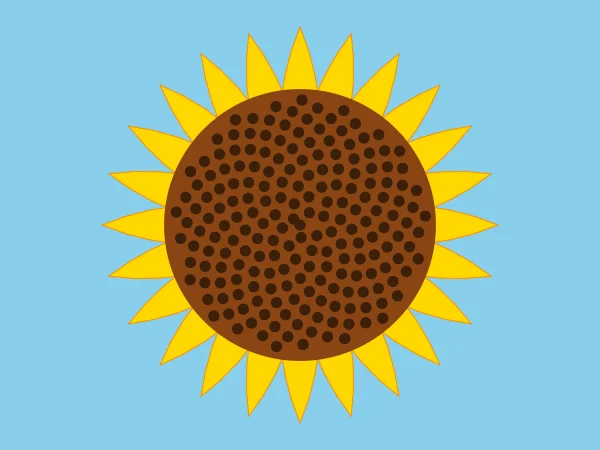
Each seed turns 137.5 degrees from the one before and sits a little further out, and that one rule packs 200 seeds into the spirals of a real sunflower.
How the code works
Thin petals
Two long, shallow arcs of 46 degrees make a thin petal that starts at the centre of the flower. The turns at the start and the end keep it pointing the way the turtle faced.
def draw_petal(size):
    # Two long arcs make a thin pointed petal that starts at the centre
    t.color("darkorange", "gold")
    t.begin_fill()
    t.right(23)          # half of 46, so the petal points straight ahead
    t.circle(size, 46)
    t.left(134)          # 180 - 46: turn round at the tip
    t.circle(size, 46)
    t.left(157)          # 134 + 23: face the way the turtle started
    t.end_fill()
Petals all the way round
24 petals, 15 degrees apart, fill the circle. A big brown dot() then covers their inner ends and becomes the seed head.
# 24 petals all the way round
for i in range(24):
    draw_petal(270)
    t.left(15)

# A brown disc covers the inner ends of the petals
t.dot(290, "saddlebrown")
Seeds by the golden angle
Seed number i sits at an angle of i * GOLDEN_ANGLE and a distance of 9.5 * math.sqrt(i) from the centre. math.cos() and math.sin() turn that angle and distance into x and y, and goto() takes the turtle there to drop a dot. The square root spreads the seeds evenly, so the head fills without gaps.
# Seeds: each one turns by the golden angle (about 137.5 degrees, the turn
# real sunflowers use) and sits a little further out than the one before
GOLDEN_ANGLE = 137.508
t.penup()
for i in range(200):
    angle = math.radians(i * GOLDEN_ANGLE)
    distance = 9.5 * math.sqrt(i)
    x = distance * math.cos(angle)
    y = distance * math.sin(angle)
    t.goto(x, y)
    t.dot(12, "#3b2008")
Make it yours
Change the code above and press Run. Some ideas:
- Change
GOLDEN_ANGLE = 137.508toGOLDEN_ANGLE = 137.0and the seeds line up in curved arms with gaps between them. - Change
t.dot(12, "#3b2008")tot.dot(8, "#3b2008")for smaller seeds that show the spirals more clearly. - Change
"gold"indraw_petalto"orangered"for a red sunflower.
What it uses
- the math module
- goto with x and y
- functions with parameters
- dot
Every turtle command the site supports is listed on Python turtle online.