Koch Snowflake in Python Turtle
Intermediate · Fractals · 48 lines · draws in about 13 seconds
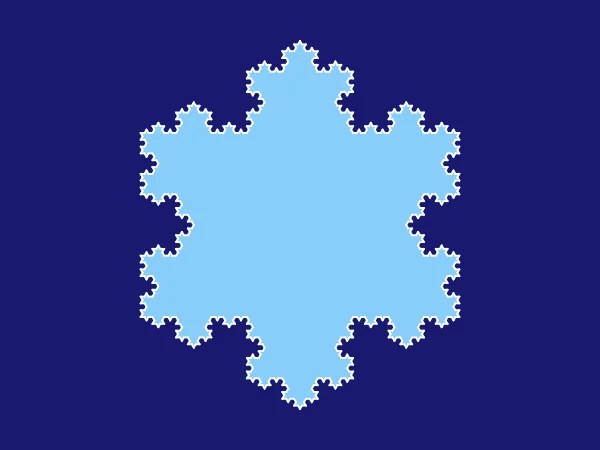
Each side of a triangle becomes a Koch line, and a Koch line is four smaller Koch lines with a bump in the middle, four levels deep.
How the code works
A Koch line
At depth 0 a Koch line is a straight line. Otherwise it is four Koch lines a third as long, and the turns left(60), right(120), left(60) lift the middle into a pointed bump. Every smaller line does the same, so the bumps get bumps.
def koch(length, depth):
    # Base case: a straight line
    if depth == 0:
        t.forward(length)
        return

    # Recursive case: four smaller Koch lines, each a third as long,
    # with a bump in the middle that points outwards
    length = length / 3
    koch(length, depth - 1)
    t.left(60)
    koch(length, depth - 1)
    t.right(120)
    koch(length, depth - 1)
    t.left(60)
    koch(length, depth - 1)
Centre the triangle
The snowflake is built on a triangle with sides of 340. Its middle is a third of its height below the top edge, so starting at (-side / 2, height / 3) puts the finished snowflake in the centre.
# Start at the top left corner of a triangle centred on the screen:
# its middle is a third of the way down from the top edge
side = 340
height = side * math.sqrt(3) / 2
t.penup()
t.goto(-side / 2, height / 3)
t.pendown()
Three sides make a snowflake
Three Koch lines with right(120) between them close the shape. The turtle goes round clockwise, so every bump points outwards, and begin_fill() with end_fill() colours the inside light blue.
# Three Koch lines, turning right after each one, make the snowflake
t.begin_fill()
for _ in range(3):
    koch(side, 4)
    t.right(120)
t.end_fill()
Make it yours
Change the code above and press Run. Some ideas:
- Change
koch(side, 4)tokoch(side, 1), then 2 and 3, to watch each level add smaller bumps. - Delete the
t.begin_fill()andt.end_fill()lines to see the outline on its own. - Change
t.color("white", "lightskyblue")tot.color("gold", "orange")for a golden star.
What it uses
- recursion
- functions with parameters
- begin_fill and end_fill
- for loops
Every turtle command the site supports is listed on Python turtle online.